
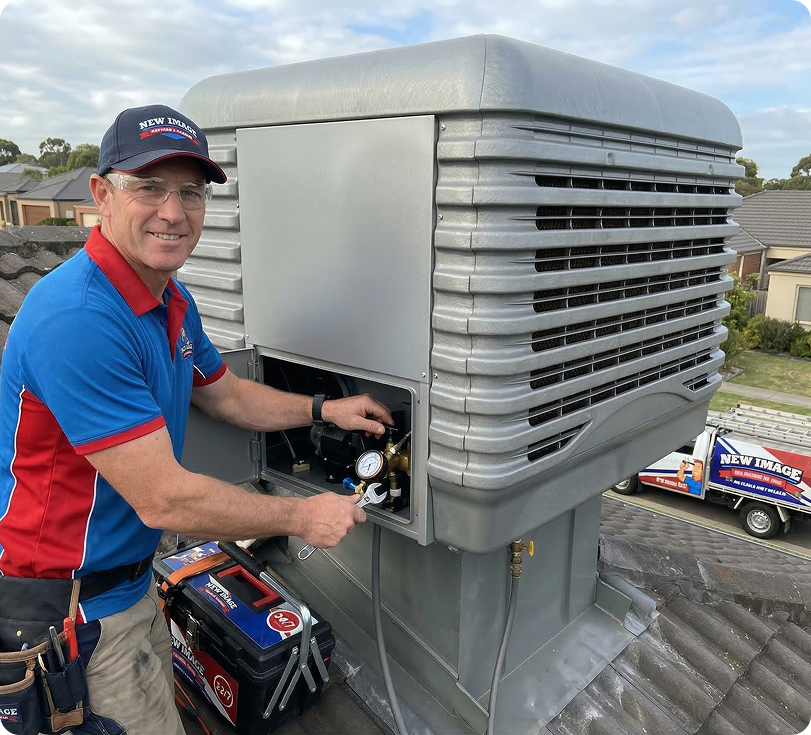
Running an evaporative cooling Melton without water is one of the most common ways homeowners accidentally damage their system, and one of the most avoidable. Whether it happens because the mains water supply was turned off, the float valve failed, a hose disconnected, or the unit was simply switched on at the start of the season before the water supply was reconnected, the consequences of dry running range from reduced cooling performance to permanent component damage.
This guide explains exactly what happens inside your evaporative cooler when it runs without water, what components are at risk, how to spot the signs of dry-run damage, and what you can do to protect your system before, during, and after the cooling season.
Why Water Is Essential to How an Evaporative Cooler Works
An evaporative cooler is not simply a fan. It is a system built around the continuous presence of water in very specific components. The pump draws water from the reservoir and delivers it to the top of the cooling pads, where it distributes evenly and trickles down through the pad material. Air drawn through the saturated pad picks up moisture through evaporation, losing heat in the process and emerging as cooler air into your home.
Every moving part in the system — the pump, the motor, the pad frame — is designed to operate within the thermal and mechanical conditions that water creates. Remove the water and the entire operating environment changes. The pump runs dry, the pads overheat from the warm air moving through them unimpeded, and the motor works against dramatically altered airflow resistance. The system is not designed for this, and it degrades quickly under these conditions.
What Happens When an Evaporative Cooler Runs Dry
The Pump Burns Out
The water pump is the component most immediately at risk when an evaporative cooler runs without water. Evaporative cooler pumps are designed to be submerged and cooled by the water they are circulating. Without water to cool and lubricate the pump mechanism, friction and heat build rapidly.
- Most evaporative cooler pumps will show signs of seal degradation within minutes of running dry, with complete failure possible within 15 to 30 minutes of continuous dry operation depending on the pump quality and ambient temperature
- The impeller — the rotating component that drives water movement — can warp or seize from overheating when deprived of the cooling and lubricating effect of water
- A pump that has been run dry may appear to resume normal function once water is restored, but the seals and impeller may be compromised in ways that lead to premature failure later in the season
- Pump replacement is the most common repair following a dry-run event. Quality replacement pumps are not expensive in isolation, but if the dry run has caused other damage, the pump replacement is only part of the repair cost
The Cooling Pads Deteriorate Rapidly
Cooling pads rely on continuous moisture to maintain their structure and function. When dry air passes through them at high speed without any water flowing, the pad material — typically a cellulose or synthetic fibre matrix — becomes brittle and can begin to break down.
- Cellulose pads are particularly vulnerable to dry-run damage. The material is designed to maintain its structural integrity through repeated wetting and drying cycles when managed correctly, but continuous dry airflow at operating fan speeds causes accelerated breakdown of the pad fibres
- Pads that have been run dry may develop uneven surfaces, cracking, or sections that no longer hold water properly when the supply is restored — compromising cooling efficiency even after the problem is resolved
- In extreme cases, pad material can shed particles into the airstream, introducing debris into the duct system and the home’s interior
- If the unit was run dry for an extended period, pad replacement should be considered even if the pads appear superficially intact, as their internal structure may have been compromised
The Motor Overheats
The fan motor in an evaporative cooler operates within a designed range of airflow resistance. When the pads are saturated with water, they provide a consistent level of resistance that the motor is engineered to work against. Dry pads offer significantly less resistance, causing the motor to spin faster and draw more current than normal.
- A motor running against reduced resistance draws excess current and generates more heat than it does under normal operating conditions
- Most modern evaporative cooler motors have thermal overload protection that will shut the motor down before it fails catastrophically — but repeated thermal cycling from dry running shortens the motor’s service life
- Older motors without adequate thermal protection can fail permanently from a single extended dry-run event — requiring motor replacement, which is one of the more costly repairs on a ducted evaporative system
No Cooling Is Produced
From the homeowner’s perspective, the most immediately obvious consequence of running an evaporative cooler without water is that it produces no cooling at all — only warm air circulation.
- Without water evaporating through the pads, there is no heat exchange, and the air entering the home is simply the ambient outside air pushed through by the fan
- On a 38-degree day in Melton, this means the system is actively pushing 38-degree air through your home — which is not only ineffective but makes the indoor temperature worse if windows and doors have been closed in anticipation of cooling
- If you turn your system on and notice it is blowing warm air and feels like nothing more than a large fan, the water supply is the first thing to check
Accelerated Scale Buildup on Internal Surfaces
This is a less immediately obvious consequence but important over time. When an evaporative cooler has been running without a proper water supply but with residual water in the system — for example, if the float valve is partially restricting supply rather than stopping it entirely — the small amount of water that does reach the pads evaporates extremely rapidly, concentrating the mineral content left behind.
- Concentrated evaporation on dry-running pads can deposit a season’s worth of mineral scale in a matter of days, severely reducing the pads’ water absorption capacity
- Mineral deposits also accumulate on the distribution channels and pump components, restricting water flow and accelerating component wear
- This type of damage is not immediately obvious but becomes apparent as reduced cooling performance and unusual operating sounds develop over the season
What Causes an Evaporative Cooler to Run Without Water
Forgetting to Reconnect the Water Supply at the Start of Season
At the end of the cooling season, it is recommended practice to turn off the water supply to the evaporative cooler and drain the system. Many homeowners follow this correctly but then forget to turn the supply back on when summer approaches and switch the system on for the first time.
- This is the most common cause of dry running at the start of the Melton summer, typically occurring in October or November when the first hot day prompts an impromptu switch-on
- Adding “turn on water supply” as an explicit step in your seasonal startup routine prevents this completely
- An annual pre-season service by a heating and cooling specialist Melton includes reconnecting and testing the water supply as part of the standard check, eliminating this risk
Float Valve Failure
The float valve controls water entry into the reservoir. While a stuck-open valve causes overflow and leaks, a float valve that fails in the closed position stops water from entering the reservoir at all.
- A scale-seized or corroded float valve that is stuck closed will allow the system to run through whatever water is left in the reservoir — and then run dry once it is exhausted
- This type of failure is particularly insidious because the system initially appears to be working normally, with the issue only becoming apparent once the cooling output drops
- Regular inspection of the float valve as part of an annual service identifies this failure mode before it can cause dry-run damage
Disconnected or Kinked Supply Hose
The flexible hose connecting the mains water supply to the evaporative cooler can become kinked, cracked, or disconnected, particularly on older installations where the hose material has become brittle from UV exposure.
- A kinked hose restricts water flow to a trickle, which may be enough to maintain a small amount of water in the reservoir but not sufficient for proper pad saturation
- A completely disconnected hose results in no water supply to the system — but may also be releasing mains pressure water elsewhere, making it both a dry-run risk and a water waste or leak issue simultaneously
- Inspecting the supply hose for condition, kinking, and secure connections is a standard part of an annual service inspection
How to Tell If Your System Has Been Running Without Water
If you are unsure whether your system has been operating without adequate water, these are the signs to look for:
- Warm air from the vents: If the system is running but the air coming through the ceiling vents is warm or only marginally cooler than ambient temperature, the pads are not being saturated
- Unusual pump noise: A pump running dry produces a different sound to normal operation — often a higher-pitched whirring or grinding as the impeller spins without water resistance
- Burning or hot smell from the unit: Overheating components, particularly the pump or motor, can produce a faint electrical or hot-plastic smell
- System cuts out shortly after starting: Thermal overload protection shutting down the motor is a sign it has overheated, which can happen rapidly during dry running
- Visible dryness around the unit or on the pads: If accessible, dry or crinkled pads with no visible moisture are a clear indicator the water supply is not reaching them
What to Do If You Realise the System Has Been Running Dry
If you discover your evaporative cooler has been operating without water, take these steps:
- Turn the system off immediately at the controller to stop further damage to the pump and motor
- Allow the system to cool for at least 30 minutes before attempting to investigate or restore the water supply
- Check and restore the water supply at the isolation tap on the supply line
- Do not immediately restart the system — allow the reservoir to fill fully before attempting to run the unit again, to ensure the pump is submerged before it starts
- Restart cautiously and observe: Listen for unusual pump noise, check whether cool air is being produced, and watch for any burning smell or rapid motor shutdown
- Book a service inspection if there are any signs of damage or if the system ran dry for more than a few minutes — a technician can assess pump, motor, and pad condition and identify damage before it worsens
Frequently Asked Questions
Can I run my evaporative cooler on fan-only mode without water?
Most ducted evaporative coolers have a fan-only mode that circulates air through the duct system without activating the pump. Running the fan without the pump does not carry the same risks as running the pump dry, and can be useful for ventilating the home in cooler weather. However, this mode provides no evaporative cooling — it simply moves air. Consult your unit’s manual to confirm whether your model supports a dedicated fan-only mode and how to activate it correctly.
How long can an evaporative cooler run without water before damage occurs?
This depends on the pump quality, ambient temperature, and the specific unit. In general, pump damage can begin within 15 to 30 minutes of continuous dry operation at high fan speed in hot conditions. Motor stress begins immediately. Some units will trip on thermal overload protection before permanent failure occurs, but this is not guaranteed. The safest approach is to treat any dry running — even a short period — as a potential damage event and have the system inspected.
Will my evaporative cooler work again if I turn the water back on after running dry?
It may resume operation, but whether it works well and for how long depends on what damage occurred during the dry run. A pump that ran dry for only a short time may continue to function normally, or it may have sustained internal seal damage that leads to failure later in the season. Restoring the water supply and cautiously restarting the unit is the right first step, but a professional inspection is strongly recommended to assess component condition and address any damage before it escalates.
Is there a way to tell if the pump has been damaged without calling a technician?
Some signs of pump damage are apparent without technical inspection: unusual noise (grinding, high-pitched whirring, or no sound at all when the pump should be running), no water reaching the pads after the supply is restored, or visible signs of overheating around the pump body. However, internal seal damage and early impeller wear are not detectable without disassembly. If you have reason to believe the pump ran dry for any meaningful period, a technician inspection is the only reliable way to assess its condition.
Conclusion
Running an evaporative cooler without water is a genuine system risk — one that can turn a perfectly serviceable unit into an expensive repair job in a very short time. The pump is at the greatest immediate risk, but the motor, pads, and internal surfaces can all be affected. The encouraging part is that this is almost entirely preventable through a simple startup routine and an annual pre-season service.
If your system has been running without water, or if you want to make sure it is in good condition before the Melton summer heat arrives, get in touch with the team at New Image Heating & Cooling. We carry out thorough pre-season inspections across Melton and western Melbourne, check every component that dry running puts at risk, and can replace a pump or pads on the spot if needed. Call us on 0468 125 098 or use our online form to get your system checked and ready for the season ahead.



