Evaporative cooling in Aintree is one of the most popular choices for many homes, and running cost is a big part of the reason why. If you are weighing up an evaporative system against refrigerative air conditioning, or simply want to understand what your existing cooler is costing you each summer, this guide breaks it down clearly. Real running costs depend on several variables, but the numbers are straightforward once you understand what drives them.
Why Does Evaporative Cooling Cost Less?
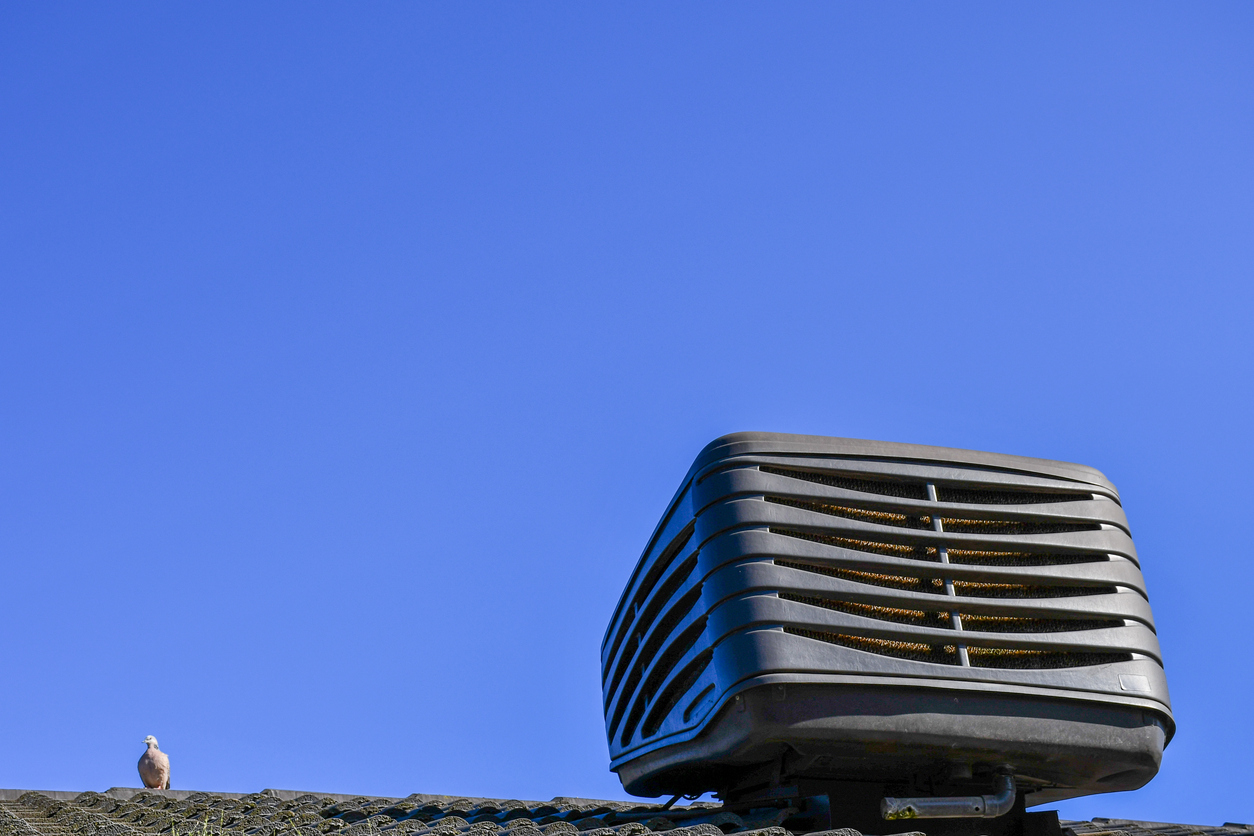
Evaporative coolers work on a fundamentally different principle to refrigerative air conditioners. Instead of compressing and expanding refrigerant gas to transfer heat, they draw warm outside air through water-saturated pads. As the air passes through the wet pads, water evaporates and absorbs heat from the air, reducing its temperature before it is blown into the home. The process requires an electric motor to run the fan and a pump to circulate water over the pads. That is it. There is no compressor, no condenser coil, and no refrigerant circuit.
This simplicity is what makes evaporative cooling so much cheaper to run. The compressor in a refrigerative air conditioner is by far its largest power draw. Without one, an evaporative cooler uses a fraction of the electricity for a comparable cooling effect under the right conditions.
Electricity Costs: What the Numbers Look Like
The electricity consumption of an evaporative cooler depends on the size of the unit, the fan speed setting, and how many hours per day it runs. Using a typical Victorian electricity rate of approximately 30 to 35 cents per kilowatt-hour (the general range for most residential tariffs in Victoria as of mid-2026, though your specific rate will vary by retailer and plan), the following figures give a realistic picture.
Small Evaporative Cooler (Up to 10 L/hr Water Use, 400–600W Motor)
Suitable for a small to medium home or a single open-plan living area.
- Power consumption: Approximately 0.4 to 0.6 kWh per hour at full fan speed
- Cost per hour: Approximately 12 to 21 cents per hour
- Cost per 8-hour day: Approximately $0.96 to $1.68
- Cost over a 90-day summer: Approximately $86 to $151 (running 8 hours per day)
Medium Evaporative Cooler (10–18 L/hr, 800W–1.2kW Motor)
The most common size for a three to four bedroom home in Aintree.
- Power consumption: Approximately 0.8 to 1.2 kWh per hour at full fan speed
- Cost per hour: Approximately 24 to 42 cents per hour
- Cost per 8-hour day: Approximately $1.92 to $3.36
- Cost over a 90-day summer: Approximately $173 to $302 (running 8 hours per day)
Large Evaporative Cooler (18+ L/hr, 1.2kW–2.0kW Motor)
Used for large homes, high-ceilinged properties, or commercial applications.
- Power consumption: Approximately 1.2 to 2.0 kWh per hour at full fan speed
- Cost per hour: Approximately 36 to 70 cents per hour
- Cost per 8-hour day: Approximately $2.88 to $5.60
- Cost over a 90-day summer: Approximately $259 to $504 (running 8 hours per day)
Most households do not run their cooler at full fan speed all day. Running at medium speed reduces power consumption by roughly 30 to 40 percent compared to the figures above, so real-world costs for typical usage patterns will often sit toward the lower end of these ranges.
Water Costs: The Other Side of the Equation
Unlike refrigerative air conditioners, evaporative coolers consume water as part of their operation. The pump circulates water over the cooling pads, and a bleed-off valve periodically flushes a small amount of water to prevent mineral build-up. Understanding water consumption is important for getting the full picture of running costs.
How Much Water Does an Evaporative Cooler Use?
Water consumption is measured in litres per hour and varies by the size and model of the unit. The figures below are approximate and represent typical evaporation and bleed-off combined:
- Small cooler: Approximately 5 to 10 litres per hour
- Medium cooler: Approximately 10 to 18 litres per hour
- Large cooler: Approximately 18 to 35 litres per hour
What Does That Cost in Water Bills?
Melbourne Water’s residential usage rates vary by tier and council area, but a general residential usage rate is approximately $2.50 to $3.50 per kilolitre (1,000 litres) for the first usage tier. Using a mid-range figure of $3.00 per kilolitre:
- Medium cooler at 14 litres/hr, running 8 hours/day: 112 litres per day, or approximately 33 cents per day in water costs
- Over a 90-day summer: Approximately 10,080 litres, or approximately $30 in water costs
Water costs are a relatively minor component of total evaporative cooling running costs for most households. Electricity is the dominant expense.
How Does It Compare to Refrigerative Air Conditioning?
The comparison with refrigerative air conditioning is where the cost advantage of evaporative cooling becomes clear. A reverse cycle split system of equivalent cooling capacity to a medium evaporative cooler typically has a compressor-driven power draw of 2.0 to 4.0 kW or more, depending on the outside temperature and the load on the system.
Side-by-Side Comparison for a Typical Aintree Home
- Medium evaporative cooler (1.0 kW average draw): Approximately $219 per summer in electricity, plus $30 in water. Total: approximately $249.
- Equivalent reverse cycle split system (2.5 kW average draw): Approximately $548 per summer in electricity, no water cost. Total: approximately $548.
The evaporative cooler costs roughly 45 percent of the equivalent refrigerative system in this comparison. The actual difference will vary depending on outside temperatures, how hard the system has to work, and your electricity tariff, but the directional difference is consistent: evaporative cooling is substantially cheaper to run than refrigerative air conditioning under the right conditions.
Factors That Affect Your Running Cost
Several variables influence how much your evaporative cooler actually costs to run over a summer season.
Pad Condition and System Maintenance
Dirty or degraded cooling pads reduce the system’s evaporative efficiency, meaning the unit has to run longer to achieve the same level of cooling. Mineral scale build-up on pads is common in areas with hard water and reduces airflow and evaporative surface area.
- Pad replacement: Cellulose pads (the most common type in residential ducted evaporative coolers) should typically be replaced every one to two seasons. Synthetic pads last longer but still require regular inspection and cleaning.
- Annual service: A professional service before the cooling season starts ensures the pump, motor, water distribution system, and pads are all working correctly. A well-maintained system costs less to run and lasts significantly longer.
Fan Speed Setting
Running the fan at the highest speed all day is not always the most economical approach. On milder days, a lower fan speed may achieve adequate comfort at significantly lower power consumption. Most modern evaporative coolers include a variable speed control or multiple fan speed settings.
- Practical tip: Use a lower fan speed in the morning when outside temperatures are moderate, and increase to high speed during peak afternoon heat. This reduces total daily electricity consumption without sacrificing comfort during the hottest part of the day.
Home Ventilation and Window Management
Evaporative coolers require windows or doors to be open to allow cooled air to push warm air out. The efficiency with which you manage this significantly affects how well the system performs and therefore how long it needs to run to achieve comfort.
- Open windows on the leeward side of the house (away from the prevailing breeze) to create a path for warm air to exit while the cooler pushes air in from the roof.
- Avoid opening too many windows simultaneously as this reduces the air speed through the home and makes the cooling effect less noticeable in occupied areas.
FAQs
Is it cheaper to run an evaporative cooler all day or just during peak heat?
Running an evaporative cooler during peak heat hours (typically 11am to 5pm in Aintree during summer) is the most cost-effective approach on most days. Starting the system early on very hot days allows it to cool the home before the worst of the heat arrives, which can reduce how hard the system needs to work in the afternoon. Running overnight on low speed can also help keep the home cooler for the following morning.
How long do evaporative coolers last before needing replacement?
A well-maintained evaporative cooler typically lasts 15 to 20 years. The motor and pump are the components most likely to require replacement before the unit reaches the end of its life. Regular annual servicing significantly extends system lifespan by catching wear on these components early and keeping the water system clean and free of scale build-up.
Why does my evaporative cooler seem less effective on some days?
Evaporative cooling efficiency drops when the relative humidity of the outside air is high. On days where humidity is above approximately 35 to 40 percent, the air is already carrying a significant moisture load and cannot absorb as much additional water through evaporation. This limits the temperature drop the system can achieve. In Melbourne’s western suburbs, very humid days are less common than on the coast, which is why evaporative cooling is particularly well-suited to areas like Aintree.
Should I turn the cooler off when I leave the house?
For short absences of a few hours during peak heat, leaving the cooler running on low speed can keep the home cooler so it does not need to work as hard when you return. For longer absences, turning the unit off is generally more economical. Modern evaporative coolers with programmable timers or app controls make it easy to schedule the system to start before you arrive home without running all day.
Conclusion
Evaporative cooling is one of the most cost-effective ways to cool a home, with running costs that are typically 40 to 60 percent lower than equivalent refrigerative air conditioning. Understanding what drives those costs, and keeping your system properly maintained, ensures you get the most out of it every summer. A well-serviced cooler with clean pads, a functioning pump, and correct ventilation management will deliver reliable, affordable comfort through the hottest months of the year.
If your evaporative cooler is due for a service, is not performing as well as it should, or you are considering a new system for your home, New Image Heating and Cooling Aintree can help. Call us on 0468 125 098 or get in touch via our online form.