
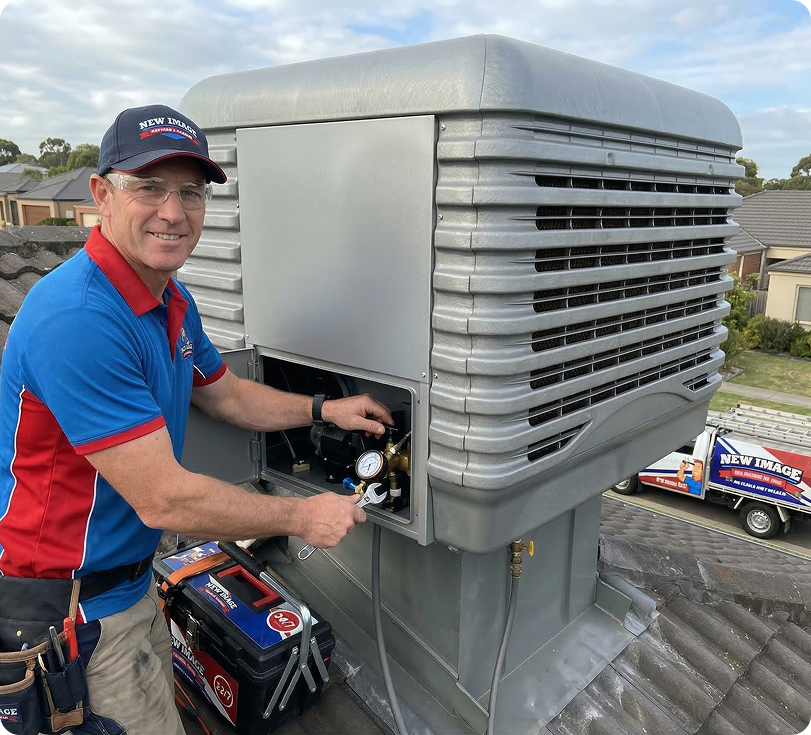
An evaporative cooling system in Melton that’s working well can keep a home genuinely comfortable through the hottest days of summer. Melbourne’s west is known for its punishing dry heat, and a well-maintained evaporative system is one of the most cost-effective ways to manage it. But a system that’s been neglected, poorly managed, or not set up correctly for the home delivers a fraction of that result for the same running cost.
The gap between a well-performing evaporative system and a poorly performing one is significant, and most of it comes down to maintenance, operating habits, and a few targeted improvements to the home itself. This guide covers every practical angle — from the system components that wear out and limit performance, to the way you manage windows and reduce the heat load your cooler is fighting against. Work through it section by section and you’ll notice the difference before summer peaks.
Start With the System Itself
Before looking at anything else, the system itself needs to be in good working order. A cooler with worn pads, blocked water outlets, or a struggling motor can’t perform well no matter how well you manage the windows or shade the house. These are the mechanical factors that most directly limit output.
Replace Worn Cooling Pads
Cooling pads are the heart of the evaporative process. Water saturates the pad, hot outside air passes through it, and evaporation drops the air temperature before it enters the home. When pads are new, they have a clean, uniform structure that holds water evenly and presents maximum surface area for evaporation. As pads age, they accumulate mineral scale from the water, their internal structure breaks down, and they lose their ability to hold water uniformly. Dry patches develop, and those patches allow warm, unfiltered air to pass straight through into the duct system without any cooling effect.
- For most homes with moderate water hardness and heavy summer use, pads should be replaced every one to two seasons.
- Premium cellulose pads outperform budget alternatives — they have a more uniform structure, hold water more evenly, and offer a larger effective evaporative surface area.
- If you don’t know when pads were last replaced, assume they’re overdue. Pads that look physically intact can still be heavily scaled and underperforming.
- After fitting new pads, run the system for a full hour before assessing cooling performance — the pads need time to fully saturate.
Clean the Water Distribution System
New pads won’t help much if the water distribution outlets are blocked by mineral scale. The distribution system feeds water across the top of each pad, and if outlets are partially or fully blocked, only some sections of the pad receive water. Those dry sections contribute nothing to cooling and simply pass warm air into the house.
- After fitting new pads, confirm the distribution tray or pipe outlets are flowing freely and wetting the entire pad surface evenly from top to bottom.
- Descale distribution outlets using a diluted vinegar solution or a purpose-made descaler — don’t use high-pressure water alone, as it can force scale further into the outlets rather than removing it.
- Check that the float valve is operating correctly so the reservoir maintains a consistent water level. A low water level means the pump can’t deliver enough flow to wet all pads properly.
- Clean the reservoir base and walls at the same time — mineral deposits and biological growth in the reservoir affect water quality and can partially block outlets even after cleaning.
Service the Motor Annually
The blower motor drives the airflow through the pads and into your home. A motor running at full rated speed moves significantly more air per minute than one where bearings are wearing or a belt has stretched. The relationship is direct: less airflow means less evaporative cooling delivered to the rooms.
- Annual motor inspection and bearing lubrication keeps the motor running at its designed output — this is particularly important in Melton and Bacchus Marsh where systems run hard through long dry stretches.
- A motor that’s running slowly but not yet failed delivers reduced airflow without triggering a complete shutdown. It’s easy to overlook as a performance factor when the system appears to be working.
- On direct-drive motors, check that the capacitor is functioning correctly — a weak capacitor causes the motor to run below rated speed and significantly reduces airflow.
- On belt-drive units, check belt tension. A loose belt slips under load and reduces the blower speed even when the motor itself is healthy.
Check Duct Condition
In older homes, flexible ductwork can develop tears, disconnected joints, or crushing over time. Cool air that leaks into the ceiling cavity before reaching the room registers is lost entirely and contributes nothing to comfort. In some cases, duct losses account for a significant portion of the total performance deficit.
- A duct inspection as part of a professional service identifies significant leaks, crushed runs, and disconnected joints.
- Flexible duct that has been compressed or sharply bent restricts airflow even when it’s intact — this can happen when insulation or other materials shift in the ceiling cavity over time.
- Register grilles and diffusers should be checked for blockages. A grille that’s been painted over or blocked by furniture reduces airflow to that room regardless of how well the rest of the system is performing.
- If all rooms are receiving noticeably less airflow than they used to, the duct system is a likely factor and warrants a roof cavity inspection.
Optimise Window Management
How you manage windows has a bigger impact on evaporative cooling performance than most homeowners realise. Unlike refrigerative air conditioning, which works in a sealed space, evaporative cooling requires airflow through the home. Hot humid air has to be able to exit, or the incoming cool air simply raises the humidity without lowering the temperature. The goal is to find the balance where warm humid air exits efficiently without so much airflow that the incoming cool air has no time to condition the space.
- Open windows partially in rooms you want coolest. This slows the air exchange and gives the cool air time to lower the room temperature before it exits. A window opened 10–15cm is usually the right starting point.
- Open windows more fully in exhaust rooms. Rooms furthest from the main living areas, or rooms you’re not actively using, can be opened more to provide an exit path for the humid air without sacrificing comfort in the main spaces.
- Never run the system with all windows closed. This is the single fastest way to destroy performance — humid air has nowhere to go, humidity builds rapidly, and the cooler achieves nothing. It feels worse than having no cooling at all.
- Use internal doors strategically. Leaving internal doors open allows airflow to move through the home and exit through accessible windows at the back or sides. Closing internal doors blocks the airflow path and limits distribution.
- Adjust as outdoor humidity changes. On drier days, open windows slightly more to increase air exchange rate. On more humid days, close windows slightly to let the system work harder on each parcel of air before it exits.
Reduce the Heat Load the System Is Fighting
An evaporative cooler doesn’t just have to cool the air coming in from outside — it has to overcome the heat that’s entering the home through windows, walls, and the ceiling. Reducing that heat load directly improves the cooler’s ability to keep the home comfortable. This is where home modifications deliver some of the highest returns for cooling performance.
Block Solar Heat Gain Through West-Facing Windows
In many homes, the afternoon solar heat load through west-facing windows is a major contributor to high indoor temperatures. The afternoon sun hits west-facing glass at near-perpendicular angles and drives enormous amounts of radiant heat into the home. Your evaporative cooler can’t keep up with a constant heat input it was never designed to overcome.
- External shading is the most effective solution. Roller shutters, external awnings, and shade cloth over west-facing windows block solar heat before it enters the glass. Internal curtains and blinds only intercept it after it’s already inside the home, which is significantly less effective.
- Close blinds and curtains before the afternoon sun reaches the glass — not after the room has already heated up. If you close them at 2pm but the sun started hitting the window at noon, two hours of heat has already entered.
- Even low-cost options like UV-blocking window film make a measurable difference for homes where external shading isn’t practical.
- North-facing windows collect heat through the middle of the day — shading these as well reduces the overall heat load the cooler faces.
Pre-Cool Before the Heat Peaks
Running the evaporative cooler from mid-morning to bring the house down to temperature before the afternoon peak is significantly more effective than trying to cool a house that’s already at 38 degrees inside. Once the thermal mass of the walls, floor, and furniture has absorbed significant heat, it radiates that heat back into the air even when the cooler is running flat out. Preventing that heat soak is far easier than reversing it.
- Melton and Bacchus Marsh typically experience peak afternoon temperatures between 2pm and 5pm on extreme heat days. Starting the cooler by 10am or 11am builds a buffer before the peak arrives.
- A house sitting at 22–23 degrees at noon requires only maintenance cooling through the afternoon peak. A house at 35 degrees at 3pm may be beyond what the evaporative system can handle on that day.
- The cooler uses less water and electricity maintaining temperature than it does trying to pull temperature down under load — pre-cooling is more economical as well as more effective.
- If you’re not home in the morning, a smart controller or basic timer can start the system automatically before the heat peak arrives.
Upgrade Ceiling Insulation
In homes where the ceiling insulation is old, thin, or missing, radiated heat from the roof cavity enters the living space continuously through summer. Roof cavities can reach 60–70 degrees on extreme heat days, and without adequate insulation, that heat radiates straight into the rooms below. Your evaporative cooler is fighting heat from above as well as from the sides — upgrading insulation removes one of those heat sources entirely.
- The current Australian standard for ceiling insulation is R3.5 to R5.0 depending on climate zone. Homes built more than 15 years ago often have significantly less than this, or degraded insulation that no longer performs to its original rating.
- Bulk insulation (batts) is the most common retrofit option. It can usually be installed in a single day by an insulation contractor.
- The return on investment is high — ceiling insulation reduces the cooling load in summer and the heating load in winter, delivering year-round running cost reductions.
- If you have evaporative cooling ducts in the ceiling, ensure the insulation contractor understands the duct layout to avoid blocking or compressing duct runs during installation.
Use the System at the Right Times
Evaporative cooling performs best when the outdoor air is hot and dry. The physics of the process depends on the air having spare capacity to absorb water vapour — when the outdoor humidity is already high, there is little evaporative capacity left and the system’s cooling effect is diminished. Understanding this relationship helps you use the system when it will actually deliver results.
- On low-humidity days with high temperatures — the classic Melton and Bacchus Marsh summer pattern — evaporative cooling performs at its best. These are the days to run the system hard and get ahead of the heat.
- On days following storms or with elevated humidity (above 50%), the evaporative effect is reduced. On these days, focus on shade management and ceiling fans to circulate air rather than expecting maximum cooling output from the evaporative system.
- Running the system on “fan only” mode on humid days circulates air and creates a wind-chill effect without adding more moisture to air that’s already carrying a high humidity load.
- Use ceiling fans alongside the evaporative system to distribute cool air from ceiling outlets more evenly through rooms and create a wind-chill effect that makes the same air temperature feel cooler. This lets you run the cooler at medium speed rather than high, reducing noise and water consumption while maintaining comfort.
When Improvement Efforts Hit Their Limit
If you’ve addressed maintenance, window management, and home heat load and the system still can’t deliver acceptable comfort on extreme heat days, the system may be genuinely undersized for the current home. This is worth a professional assessment before investing in more improvements. Extensions, open-plan renovations, and additional rooms can change a home’s cooling load significantly from the original design spec.
- A technician can calculate whether the system’s rated airflow output matches the home’s current cooling load — this assessment takes about 30 minutes and gives a clear answer on whether more optimisation will help or whether an upgrade is the more practical path.
- Options when a system is genuinely undersized include upgrading to a larger evaporative unit, adding a supplementary split system for the main living areas on extreme days, or a hybrid approach using both systems strategically.
- An honest assessment from a local technician is more useful than continued attempts to optimise a system that’s simply too small for the job.
- New Image Heating and Cooling can carry out this assessment for homes in West Melbourne and give you a clear, unbiased recommendation based on your specific home and budget.
Conclusion
Getting more out of your evaporative cooler isn’t complicated, but it does require attention to the right things in the right order. Start with the system — pads, water distribution, motor, and ducts. Then tackle the home — shading, pre-cooling, and insulation. Then adjust how and when you operate it. Done properly, most systems in Melton and Bacchus Marsh can deliver significantly better results than homeowners are currently getting from them.
If your system needs a service, a pad replacement, or a full performance assessment, New Image Heating and Cooling Melton is available. We give you honest advice on what will and won’t make a practical difference for your specific setup. Call 0468 125 098 or submit our online form today. Book before noon for same-day availability.
Frequently Asked Questions
Will a higher-quality replacement pad improve cooling performance significantly?
Yes. There is a real difference between quality cellulose pads and budget alternatives. Premium pads have a more uniform structure, hold water more evenly, and provide a larger effective evaporative surface area per pad. The improvement from replacing old degraded pads with quality new ones is one of the most noticeable single maintenance steps you can take.
My evaporative cooler is several years old. Is it worth upgrading to a new unit?
Modern evaporative cooling units are more efficient and quieter than units from ten or more years ago. A new unit resets the component wear clock, meaning motors, pumps, and duct fittings are all fresh. If your current system is approaching the end of its reliable life and you’re spending repeatedly on repairs, a replacement conversation is worth having. New Image Heating and Cooling can give you an honest assessment across Melton and Bacchus Marsh.
Does running the evaporative cooler on high speed always give better performance?
Not always. Higher fan speeds move more air but also cycle it through the space more quickly, which can reduce the time the cool air has to lower the room temperature. In very large open spaces, high speed distributes air well. In smaller or more enclosed rooms, medium speed often produces better temperature results with less noise. Experiment with different speeds to find what works best for your specific home layout.
Can using a water additive improve cooling performance?
Water additives designed for evaporative coolers primarily target biological growth prevention (algae, bacteria) rather than improved cooling performance. They’re a legitimate preventive maintenance product for odour and biological growth but won’t meaningfully change the temperature drop the system achieves. Performance improvement comes from pad condition, distribution efficiency, and motor airflow, not water chemistry.
Will ceiling fans help my evaporative cooler work better?
Yes. Ceiling fans running anticlockwise (when viewed from below) in summer distribute cool air from the evaporative cooler ceiling outlets more evenly through the room and create a wind-chill effect that makes the same air temperature feel cooler. Using ceiling fans alongside the evaporative cooler allows you to achieve the same comfort level with slightly less aggressive cooling output, which is more efficient overall.



