
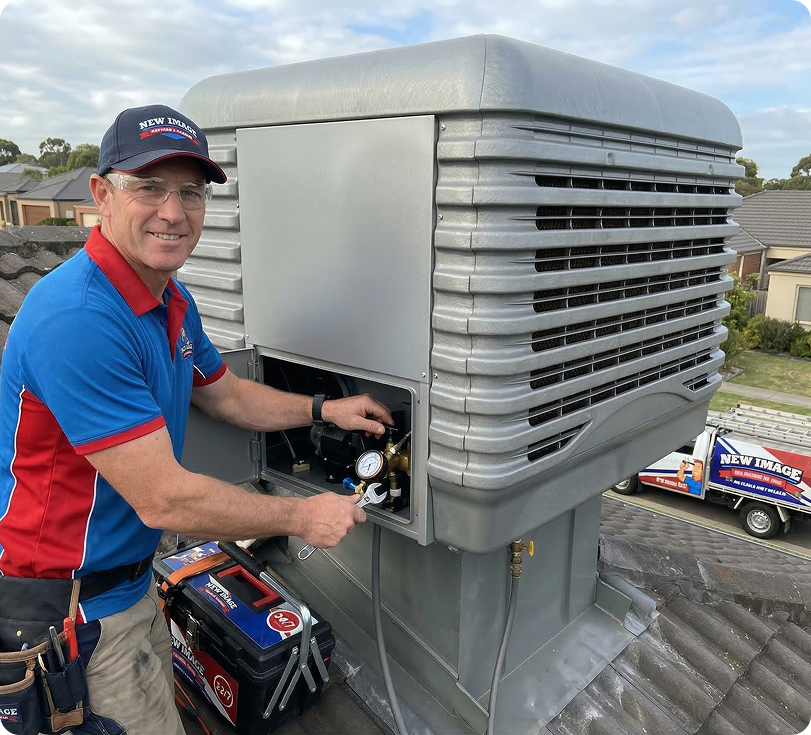
Homeowners have been weighing up evaporative cooling against refrigerated air conditioning Melton and Bacchus Marsh, and the debate persists because there is no single correct answer. Both systems cool effectively in the right conditions. Both can underperform badly in the wrong ones. Understanding how each works — and where each has real limits — is the only way to make a decision that you will not regret after the first summer. This guide covers the mechanics, the performance differences, the running costs, the maintenance requirements, and the specific climate characteristics of Melton and Bacchus Marsh that make this choice different here than it would be in Sydney or Brisbane.
How Evaporative Cooling Works
Evaporative cooling is a straightforward technology based on a natural physical process: evaporation absorbs heat. Understanding the mechanics helps explain both why it works so well in the right conditions and why it fails in the wrong ones.
The Core Mechanics
- An evaporative cooler draws warm outside air through water-saturated cooling pads, typically made from cellulose or synthetic materials
- As water evaporates from the pads, it absorbs heat from the passing air, reducing the air temperature before it is delivered into the home
- The cooled, humidified air is pushed through ducts and vents into living areas by a centrifugal fan
- Windows or doors in the home must remain partially open to allow warm air to escape as cooler air is delivered — evaporative cooling requires airflow through the building to work
- The system runs continuously, constantly drawing in fresh outside air rather than recirculating indoor air
Where Evaporative Cooling Performs Best
- Low-humidity conditions are essential — evaporation works best when the incoming air is dry, because dry air can absorb more water vapour, producing a greater temperature drop
- On a 38-degree day with low humidity in Melton, a well-maintained evaporative system can deliver genuinely comfortable indoor temperatures at a fraction of the running cost of a refrigerated system
- The western corridor of Melbourne — including Melton and Bacchus Marsh — typically experiences drier summer conditions than bayside or eastern suburbs, which suits evaporative cooling well
Where Evaporative Cooling Struggles
- On humid days — particularly during weather systems from the bay or during multi-day heat events — the air is already carrying significant moisture, which reduces the evaporation rate from the pads and limits the cooling effect
- During overnight periods in extended heat events where temperatures stay high and humidity rises, an evaporative system may be unable to maintain comfortable indoor conditions
- Evaporative cooling adds moisture to indoor air, which can be uncomfortable on already-humid days
- The system cannot be run with windows and doors closed — homes that are well-sealed for security or noise reasons may not be suitable candidates
How Refrigerated Air Conditioning Works
Refrigerated air conditioning — whether a wall-mounted split system or a ducted reverse-cycle system — operates on a fundamentally different principle that makes it independent of outdoor humidity.
The Core Mechanics
- A refrigerant circulates between an indoor and outdoor unit, absorbing heat from indoor air at the evaporator coil and rejecting that heat outside at the condenser coil
- The process does not rely on evaporation of water — it relies on the thermodynamic properties of the refrigerant, which makes it equally effective regardless of outdoor humidity levels
- On a 40-degree day with 90% humidity, a refrigerated system performs the same as on a 40-degree day with 15% humidity — humidity is irrelevant to its operation
- As refrigerated systems cool the air, they also condense and remove moisture from it, which actively dehumidifies the indoor environment and adds a comfort benefit in humid conditions
The Reverse-Cycle Advantage
- Modern split systems and ducted systems are reverse-cycle, meaning the refrigerant cycle can be run in reverse to extract heat from outside air and deliver it indoors during winter
- This gives a single system the ability to both heat and cool, eliminating the need for a separate heating system
- In Melton and Bacchus Marsh, where winters are genuinely cold and heating is required for five or more months per year, the ability to consolidate heating and cooling into one system has real practical and cost value
- Modern reverse-cycle systems maintain effective heating output even when outdoor temperatures drop to 2-3 degrees Celsius, covering all but the most extreme Melton winter nights
The Trade-Offs
- Refrigerated systems are generally more expensive to purchase and install than evaporative systems of comparable capacity
- Running costs per hour of operation are higher — the compressor is the primary electrical load, compared to a fan motor in an evaporative unit
- On a moderate summer day where an evaporative system would perform well, the evaporative option is considerably cheaper to run
The Melton and Bacchus Marsh Climate Context
The specific climate characteristics of Melton and Bacchus Marsh are an important part of this decision. The area sits in Melbourne’s western corridor, which has different summer conditions than the inner city or the bayside suburbs.
Summer Climate Characteristics
- Melton and Bacchus Marsh experience hot, dry summers with lower average humidity than bayside or eastern Melbourne suburbs, which is a genuine advantage for evaporative cooling performance
- The area is subject to Melbourne’s well-known “four seasons in one day” weather patterns, including rapid temperature swings within a single day that can challenge both system types
- Multi-day heat events — several consecutive days above 35 degrees — do occur and are when the humidity limitation of evaporative cooling is most likely to be felt
- Bushfire smoke events, while infrequent, require windows to be kept closed for health reasons — during these periods, an evaporative system cannot be operated
Why the Location Matters for the Decision
- Homes in Melton and Bacchus Marsh sit closer to the evaporative-friendly end of the Melbourne climate spectrum than homes in bayside or eastern suburbs, making evaporative cooling a more viable option here than in many other parts of the city
- Melbourne’s “four seasons in one day” pattern is a genuine argument for a reverse-cycle system that can heat in the morning and cool in the afternoon without manual intervention
- If your home already has evaporative cooling installed and you are considering switching to refrigerated ducted, the cost of duct removal or conversion needs to be factored in — in some homes the existing ductwork is compatible with a refrigerated system, in others it is not
Running Costs and Energy Consumption
Running costs are one of the most common drivers of the evaporative-versus-refrigerated decision, and the comparison is more nuanced than it is often presented.
Evaporative Cooling Running Costs
- The primary electrical load in an evaporative cooler is the fan motor, which uses considerably less electricity than a refrigerant compressor
- A typical residential evaporative system uses roughly 1 to 3 kWh of electricity per hour of operation, depending on system size and fan speed
- The system also consumes water continuously — typically 4 to 25 litres per hour depending on system size, conditions, and pad efficiency — which adds a small ongoing water cost
- Water consumption is worth noting given Victoria’s periodic water restrictions and the ongoing cost of mains water supply
Refrigerated System Running Costs
- A typical residential split system or ducted reverse-cycle unit uses 1 to 4 kWh per hour in cooling mode depending on system size and operating conditions, with the compressor as the primary load
- However, modern inverter-driven systems modulate their compressor speed to match the load, which significantly improves efficiency compared to older fixed-speed systems
- Households with solar panels can substantially offset refrigerated system running costs by running the system during peak solar generation hours — this narrows the running cost gap with evaporative cooling considerably
- In heating mode, reverse-cycle systems are significantly cheaper to run than gas ducted heating per unit of heat delivered, particularly at current gas prices
Maintenance Requirements
Both system types require regular maintenance to perform reliably and safely. Neither is genuinely low-maintenance over its lifespan.
Evaporative System Maintenance
- Cooling pads should be inspected annually and replaced every one to three years depending on water quality and pad material — degraded pads reduce cooling efficiency and can harbour bacteria
- The sump (the water reservoir at the base of the unit) requires cleaning at the start and end of each cooling season to prevent mineral scale, algae, and bacterial growth
- The distribution system that delivers water to the pads should be checked for blockages or uneven flow
- The unit should be winterised at the end of each cooling season to prevent water sitting in the sump and freezing or developing bacterial growth over winter
- The roof-mounted unit, pump, and float valve should be checked by a heating and cooling specialist Melton annually
Refrigerated System Maintenance
- Indoor unit filters should be cleaned every two to three months during active use — blocked filters reduce airflow and can cause the evaporator coil to ice up
- The outdoor unit should be kept clear of debris, foliage, and obstructions that restrict airflow across the condenser coil
- An annual professional service checks refrigerant charge, electrical connections, coil condition, and drain operation
- Ducted systems require duct inspection every few years to check for disconnections, tears, and pest damage in the roof space
Which One Is Right for Your Home?
There is no universal right answer, but there are clear indicators that point toward one system or the other depending on your situation.
Evaporative Cooling Is Worth Considering If:
- Your home is in Melton or Bacchus Marsh and you primarily need cooling rather than year-round climate control
- You already have a ducted gas heating system and want to add cooling without replacing the existing heating setup
- Running cost is a primary concern and you can accept some performance limitation on the most humid days
- Your home has good cross-ventilation and the lifestyle of keeping windows partially open suits your household
- You are comfortable with the seasonal maintenance requirements and water consumption
Refrigerated Air Conditioning Is Worth Considering If:
- You want reliable cooling performance regardless of weather conditions, including the most humid and extended heat events
- You need both heating and cooling from a single system, particularly if your existing heating system is old or due for replacement
- Your home is well-sealed — for noise, security, or allergy reasons — and opening windows during operation is not practical
- Bushfire smoke or air quality events are a concern and you need the ability to cool the home with all openings sealed
- You have solar panels and can run the system during peak solar generation hours to offset the higher electricity cost
Conclusion
The evaporative-versus-refrigerated decision is genuinely home-specific. The right answer for a four-bedroom brick veneer in Melton South with good cross-ventilation and an existing gas heater may be completely different from the right answer for a well-insulated new build in Bacchus Marsh with no existing HVAC system at all.
New Image Heating and Cooling Bacchus Marsh and Melton services and installs both evaporative cooling and refrigerated air conditioning systems. We will give you an honest recommendation based on your actual home, your suburb’s climate characteristics, and your budget — not on what happens to be easier or more profitable for us to install.
Call us on 0468 125 098 for a free, no-obligation assessment and quote. Same-day bookings are available for calls before noon. If you are not sure which system is right for you, that is exactly the conversation we are set up to have.
Frequently Asked Questions
Can I run evaporative cooling when it is humid?
You can, but the cooling effect is reduced. Evaporative cooling relies on dry air for maximum efficiency. On humid Melbourne days — particularly during extended heat events where overnight temperatures stay high — a refrigerated system will outperform an evaporative one. This is less of a concern in Melton and Bacchus Marsh than in bayside areas, but it is still a real limitation.
Can I convert my evaporative cooling system to refrigerated ducted?
Sometimes. It depends on the existing ductwork configuration. In some homes, the duct layout used for evaporative cooling is compatible with a ducted refrigerated system. In others, the duct sizing or layout doesn’t translate, and new ducting is required. A technician can assess your existing system and advise whether conversion is practical and cost-effective for your specific home.
How much more expensive is refrigerated air conditioning to run compared to evaporative cooling?
Running costs vary by system size, conditions, and energy prices. Generally, evaporative cooling uses significantly less electricity per hour than refrigerated systems — primarily because a fan motor is the main load rather than a compressor. However, if you have solar panels and run a refrigerated system during peak generation hours, the effective running cost gap narrows considerably.



